
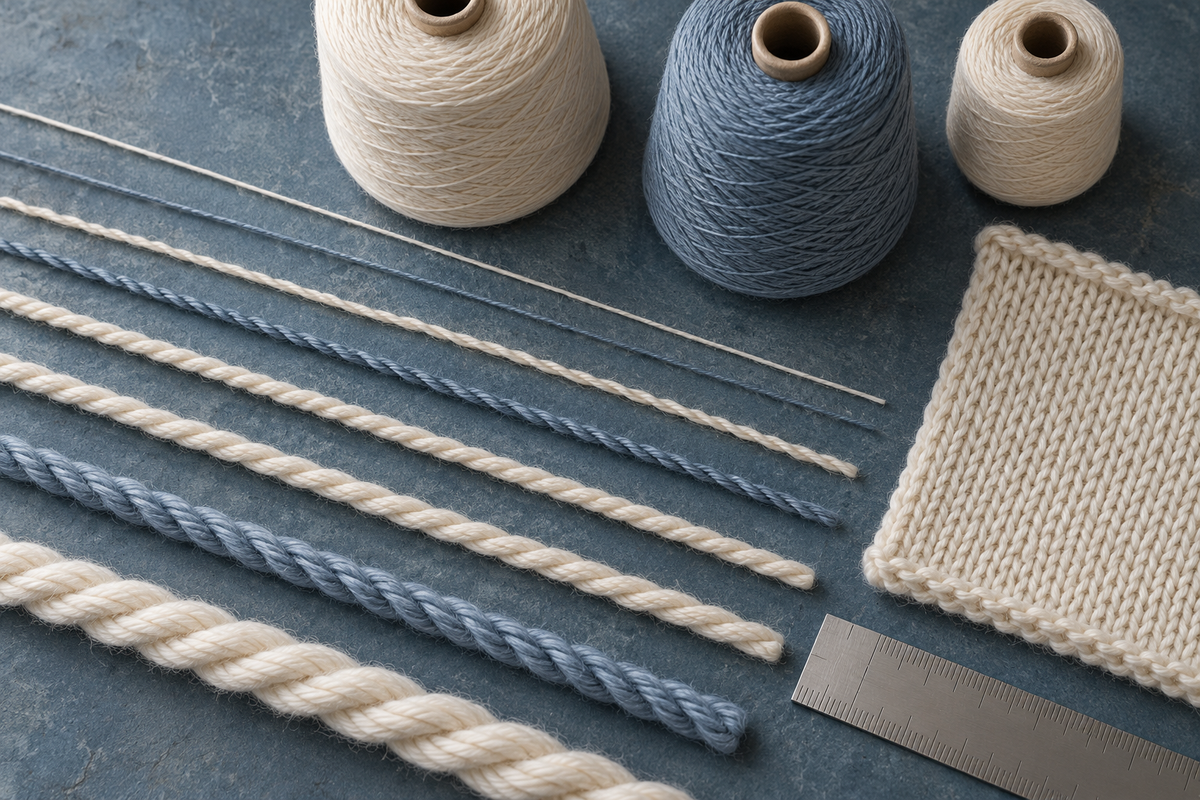
A product listing says “count 15”. Another says “30/2”. A third uses tex. Those numbers can look comparable at first glance, yet an order brief needs more context before they can guide a buying decision. The safest habit is to preserve the supplier’s complete notation and ask what each part means.
This matters when a design passes between a buyer, a supplier and a knitting team. An abbreviated number can lose its original meaning in an email or spreadsheet. A slightly longer specification, kept with the reference and swatch, gives everyone a firmer starting point.
A count always belongs to a system
Yarn count expresses yarn size through a relationship between mass and length. CottonWorks identifies English Cotton Count, or Ne, as an indirect system: a higher number represents a finer yarn. Other systems use different conventions, so a bare number should never be treated as a complete size specification.
Ask for the system name, the full count notation and whether the figure refers to a single strand or the assembled yarn. Keep that wording in the purchase file. If a conversion is needed, have the responsible technical team confirm it and retain the original alongside the converted figure.

Ply and twist add necessary context
A plied yarn is made by twisting together two or more single yarns. CottonWorks gives Ne 24/1 and Ne 48/2 as examples with the same equivalent count, while their construction differs. Twist can be described by direction and by a level such as turns per metre or turns per inch. Always carry the unit into the conversation.
These terms help describe the yarn you are discussing. They do not, by themselves, specify the finished fabric or guarantee that a yarn will suit a particular machine. Use them to ask better questions, then confirm the result through sampling.
| Listing detail | Question to ask | Keep in the record |
|---|---|---|
| Count | Which numbering system is used? | Original notation and system name |
| Ply | Is this a single or assembled yarn? | Construction as supplied |
| Twist | Which direction and unit describe it? | Supplier’s stated specification |
| Use | What sampling setup should we evaluate? | Machine, gauge, stitch and finish |
Build a comparison sheet that survives handovers
Create one row per yarn reference. Include the supplier code, composition, count exactly as written, colour reference and the date the information was confirmed. Put the swatch photograph beside these fields. If a detail is still open, mark it as awaiting confirmation instead of filling the space with an assumption.
Add a separate area for observations from your sample. “Clear stitch outline after our finishing trial” is more useful than an unexplained “good”. Keep the trial settings nearby, because the next person needs to understand how that result was obtained. A small, well-labelled file is easier to reuse than a long email chain.
Discuss machine suitability with the sampling team
Before buying for production, share the yarn details with the people making the sample. Describe your intended fabric and ask what information they need. If two options need different setups, document each trial separately. Comparing the resulting fabrics can still be useful, provided the differences in setup are visible.
When the project changes, revisit the brief. A new stitch pattern, a revised weight target or a different finishing route may require another trial. The previous approval remains valuable evidence of what was made, rather than automatic approval of every future variation.
Copy this into your next enquiry
- Product reference and full composition
- Count exactly as listed, with the system confirmed
- Single or plied construction
- Twist details where required, including the unit
- Intended machine, gauge, stitch and finishing route
- Sample quantity, colour reference and delivery destination
Browse the yarn collection with these questions in mind. If a listing leaves a technical detail open, send the product reference through our enquiry page before ordering. A shared definition at the beginning can save several rounds of clarification later.
Compare actual yarn references
Use the photographs below to connect this guide with a specific product code and card. Each page records the available specification and any details that need confirmation.


Contact us to confirm the exact yarn, complete shade code and availability before checkout. One confirmed, individually packed 1kg sample is US$19.90, with shipping additional. Evaluate the physical yarn before discussing a quantity-based bulk quotation.
Sources & further reading
CottonWorks by Cotton Incorporated — Yarn Spinning, Yarn Twist and Terms to Know (accessed 23 October 2026).
Industry sources inform the short fibre and terminology notes above. The sourcing workflow and checklists are le Charchell editorial guidance. Illustrations are created for this journal and do not represent specific stock, laboratory results or certifications.