
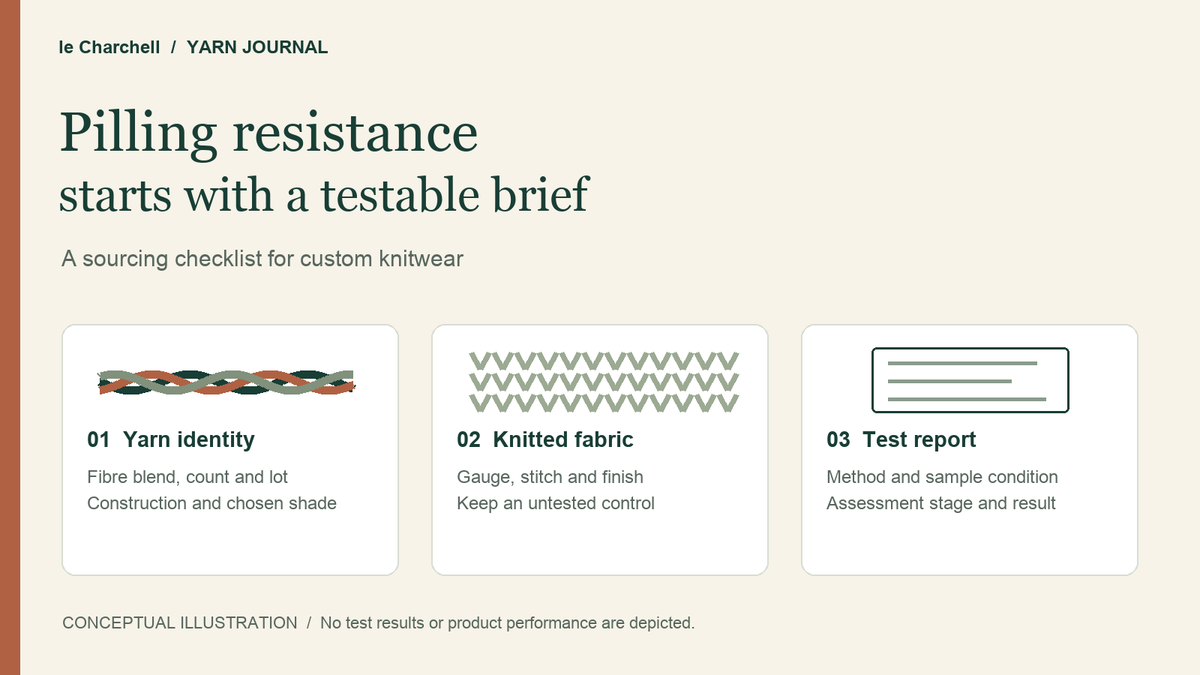
Published 4 November 2026 · A practical sourcing guide for knitwear developers and wholesale yarn buyers.
Before approving a yarn described as anti-pilling, put the intended sweater and its test requirements on the same brief. A soft cone, a clean colour card and a familiar fibre blend help you shortlist a yarn. A pilling claim needs evidence from a defined fabric sample and a stated test.
This guide explains what to ask a yarn supplier, what to record during sampling and how to discuss testing with a laboratory. It also shows how to use a le Charchell 1kg sample before requesting a bulk quotation. The colour-card photographs illustrate our catalogue; they do not show laboratory results.
What buyers should mean by anti-pilling yarn
Pills are small balls of tangled fibres that remain on a fabric surface. Woolmark explains that rubbing during wear can create them, particularly in areas where a sweater repeatedly contacts itself or another surface. Its guidance also identifies fibre length, twist and fabric cover as design considerations. These are useful discussion points, rather than proof that a particular yarn will meet your specification. Read Woolmark's explanation of pilling.
Ask what the supplier's description refers to: a fibre selection, a spinning adjustment, a finishing process or an existing test report. If a report is available, check that it identifies the exact article and fabric construction. A result for another blend, a different knitted structure or a previous production lot needs further discussion before you use it to approve your order.
Use the article reference to make the discussion specific
For example, our Y100-000067 viscose and PBT yarn sample has a stated composition of 72% viscose and 28% PBT. Its source card lists 32S/2 and 50Nm/2 count options and XM-series shade codes. Confirm which count and shade you want before ordering. Those details identify your enquiry; the fibre percentages and the card alone do not establish a pilling rating.
Send the reference with your intended knit structure and ask what supporting evidence is available for the selected specification. If your customer requires a particular pilling result, include that requirement in the brief so the sample fabric and test plan can be agreed before bulk approval.

Write the garment brief before comparing yarns
A fine-gauge cardigan, a brushed sweater and a dense ribbed cuff present different surfaces. Describe the garment category, target handle, intended knit structure and care route. Include your machine gauge and proposed number of ends. Keep the yarn reference, count notation and selected shade beside that information so that the knitting team and supplier discuss the same material.
ASTM notes that fibre characteristics, yarn and fabric construction, finishing and conditions of use all affect pilling. It also allows parties to agree whether to assess fabric as received, after care, or in both states. Record that decision before comparing results. See ASTM's published scope and guidance for D4970/D4970M.
For an initial comparison, keep the knit recipe and finishing instructions consistent across candidate yarns where feasible. If you change the recipe to suit a material, label that panel separately. You can then judge each proposed garment fabric and see which construction was actually tested.
Choose a method with the laboratory
Send the laboratory a description or photograph of the proposed fabric before booking a test. State any retailer or customer protocol you must follow. Ask the laboratory to confirm method suitability, specimen quantity and preparation requirements for that construction.
| Reference | Published scope | Buyer action |
|---|---|---|
| ISO 12945-2:2020 | Fabric pilling, fuzzing and matting assessed by a modified Martindale method. | Confirm the applicable edition, fabric suitability and required assessment stages. |
| ASTM D4970/D4970M-22(2026) | Pilling resistance and related fabric surface changes using a Martindale tester. | Agree the reporting details and how results will inform the buying decision. |
The references above come from the official ISO listing and ASTM listing, checked for this article. The ASTM guidance cautions against using its method for acceptance testing without careful agreement. A test-method name alone does not provide a universal pass level.
Construction matters when choosing the test. RISE's textile laboratory describes its ISO 12945-2 service for woven and knitted fabrics while excluding heavy knitwear from that service. Buyers of bulky, hairy or unusual structures should ask their chosen laboratory directly how to assess the proposed fabric. Read RISE's service description.

Keep a record that can travel with the sample
Give each knitted panel its own identifier. Attach the same identifier to the lab request, photographs and approval email. The following record helps prevent a test result being separated from the material and production settings that created it.
| Record | Details to keep |
|---|---|
| Material identity | Supplier, article reference, fibre blend, count, shade code and lot information. |
| Knitting recipe | Machine gauge, ends, stitch structure, settings and finished panel measurements. |
| Preparation | Finishing route, care treatment and the state supplied to the laboratory. |
| Test instruction | Method and edition, requested assessment stages and agreed customer criteria. |
| Decision | Report number, panel photographs, approver, date and any follow-up required. |
Keep an untested control panel and photograph samples under consistent lighting. Avoid comparing a freshly finished panel with an older washed sample without labelling the difference. When a laboratory reports a rating, keep the full report and its assessment stage alongside the number.

Turn an approval into a clearer bulk enquiry
Send the supplier your approved panel identifier with the yarn reference, chosen shade, planned quantity and required delivery window. Include the agreed fabric-test brief where performance is part of the order. Ask what can be held consistent in bulk supply and how any material, lot or finishing change will be communicated.
If a candidate misses your requirement, record the change you want to trial next. A revised twist, knit density or finish creates a new sampling decision that should be identified and reassessed. Keep your original control so the development team can see what improved and what changed in handle or appearance.

Start with a confirmed 1kg sample
le Charchell supplies 1kg yarn samples at US$19.90 per sample, with shipping charged separately. Use a sample to inspect the selected colour and material and develop your knitting trial. Confirm with your laboratory how much finished fabric it requires; a sample purchase does not include testing or a guaranteed performance rating.
Before placing an order, contact us to confirm the product specification, available shade and quantity. After we agree the shade, enter its complete code in the product page's Colour reference field and repeat it in the order note. This keeps the fulfilment instruction attached to your sample order.
After you approve the sample, send your bulk quantity for a separate quotation. We can discuss quantity-based pricing against the selected material and order requirements. Browse our yarn catalogue or send your yarn brief on WhatsApp. You can also email zncainan@gmail.com.
le Charchell is operated by KAINOR CLOTHING LIMITED. This article offers a sourcing checklist; laboratory suitability, test conditions and acceptance criteria must be agreed for the actual fabric. No anti-pilling certification or result is asserted for the products pictured.