
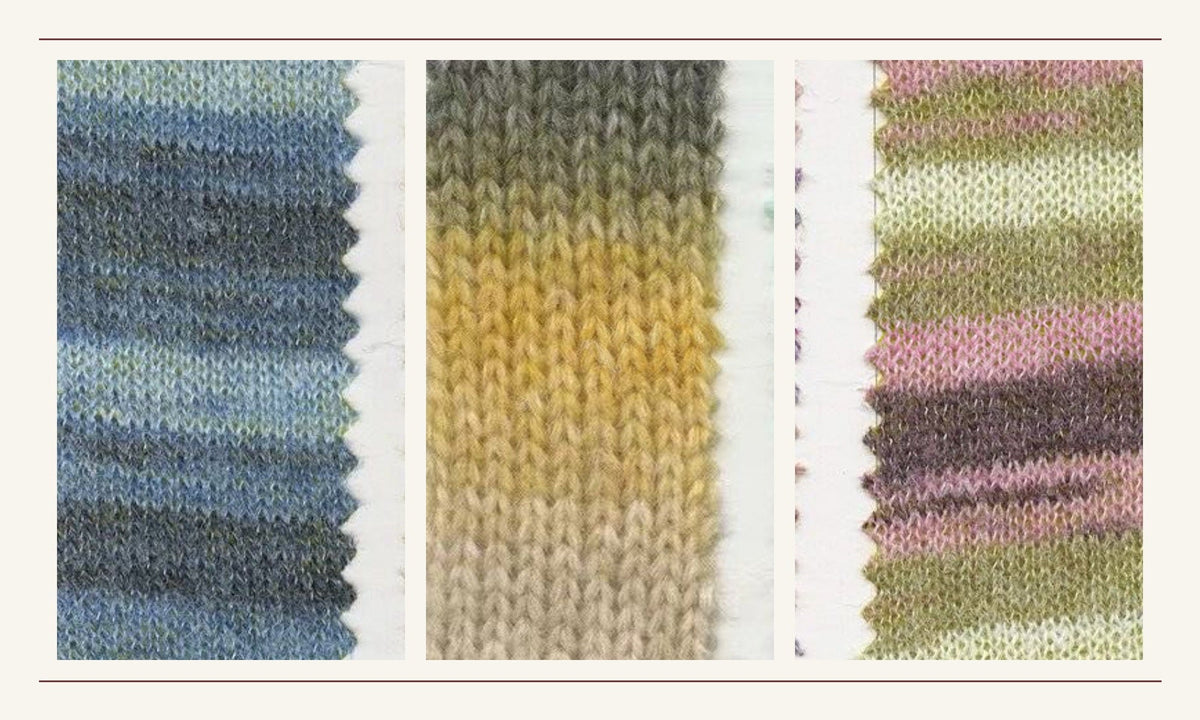
A gradient looks continuous on a cone. Across a sweater, the same yarn can create broad bands on a sleeve, smaller colour areas on a body panel, and an unexpected change at the armhole. For knitwear development, the useful question is how the colour sequence behaves in the actual garment.
Open any article image to view it at full size.
Colour and fabric development remain closely connected in current collection planning. In its February 2026 introduction to Spring/Summer 2027, Filmar describes new colour cards alongside knitted panels in different stitches and constructions. For gradient-yarn development, that is a useful habit: assess colour through fabric. This guide focuses on developing the colour effect reliably enough to approve a production direction.
Agree on the colour effect before approving the yarn
Supplier terminology varies. Use the following distinctions as questions for the selected yarn, rather than assuming that a descriptive name guarantees a particular garment effect.
| Description | What to establish | Production implication |
|---|---|---|
| Gradient | How colours transition, and whether the sequence returns to its beginning. | A gradual change may extend beyond one small test panel. |
| Long colour repeat | The complete repeating sequence and variation between repeats. | Panel width and starting position affect where colours appear. |
| Space-dyed | The arrangement of coloured sections along the yarn, including whether it is regular. | Expect to test distribution; the label alone does not promise stripes. |
| Self-striping | The fabric conditions under which the supplier demonstrates stripes. | A stripe effect shown at one width may change on another garment part. |
Skein Yarn's own dye-technique guide separates gradient and long-repeat effects from other colour treatments, and describes pooling as repeated colour gathering in the same fabric region. Its descriptions concern its own yarns; confirm equivalent information with your supplier.
Space dyeing also covers more than one production route. Machinery manufacturer Superba demonstrates alternating coloured zones in its carpet-yarn system. That example explains the broad principle, not the dyeing process, segment length or performance of a knitwear yarn in our catalogue.
Why the same yarn changes across garment parts
Every stitch consumes some yarn. A wider panel generally consumes more yarn per course than a narrower panel knitted under comparable conditions. Changing the stitch structure, stitch length or number of ends can change consumption too. Consequently, a coloured section that spans several courses in one fabric may cover a different number in another.
Katia's planned-pooling tutorial demonstrates how colour sequence, stitch choice and consistent tension interact in a specific crochet project. It is useful evidence of the relationship, not a machine-knitting recipe. A production knitter must establish the equivalent behaviour on the chosen equipment and construction.
A small illustrative calculation
Imagine a yarn with a perfectly regular 6-metre complete colour repeat. If a test fabric consumes 1.5 metres per course, one repeat supplies about four courses. At 3 metres per course, it supplies about two. These are invented values illustrating the ratio:
Courses supplied by one repeat ≈ repeat length ÷ measured yarn consumption per course.
This estimates sequence frequency, not stripe height or exact placement. Each individual colour occupies only part of the repeat. Shaping, return direction, stitch structure, feeding, tension, multiple ends and colour-length variation can alter the result. Measure consumption on representative fabric and confirm appearance by knitting it.

A five-step trial for production knitwear
1. Map the sequence and package direction
Ask whether the selected shade has a regular repeat, a non-repeating progression or intentionally variable colour placement. Record the lot, package identification, unwinding direction and observed order of colours. Compare several available packages. Similar-looking cones may begin at different points within the sequence.
2. Establish a controlled baseline
Have the technician choose a suitable machine setup for the confirmed yarn specification. Record machine, gauge, ends, stitch construction and settings. Knit enough fabric to observe the relevant colour development. Keep a labelled control panel, and change one trial variable at a time so that the reason for a different appearance remains visible.
3. Knit the widths that the garment needs
Compare a body panel, sleeve and shaped section using the intended construction. Include the garment sizes most likely to expose a width difference. An attractive narrow strip cannot establish how an oversized front will look. Photograph each trial at the same scale, with its orientation and start point identified.
4. Decide what must match
Define whether fronts, backs, sleeves and cardigan halves should align, broadly coordinate or intentionally differ. For a matching trial, have the knitter start comparable panels at a documented colour boundary and sequence direction. Matching their start does not guarantee matching throughout different shapes. Assemble the test pieces, then evaluate seams, ribs, necklines and package joins together.
For example, an illustrative brief might accept softly different body and sleeve bands while requiring the two cardigan fronts to coordinate at the hem. That decision gives the technician a specific comparison to make. An instruction such as “match all colours” leaves the critical locations and acceptable differences undefined.

5. Approve after the intended finishing trial
Finish a trial through the proposed production route, then compare it with the retained unfinished control. Assess colour placement, dimensions, surface and appearance at seams. Keep an approved reference plus an agreed range of acceptable variation. Record joining waste and development usage separately from net garment usage before setting the bulk yarn allowance.
Diagnose the appearance before changing the setup
| Observation | Check first | Useful next trial |
|---|---|---|
| Large colour patches | Whether repeated colours are accumulating in similar positions. | Compare a controlled width or structure change with the baseline. |
| Sleeves differ from the body | Consumption per course, shaping and starting position. | Compare actual garment-part widths side by side. |
| Sudden change at a join | Sequence direction and the colour positions being joined. | Test and record a practical joining method with the technician. |
| Packages look inconsistent | Lot, selected shade, package starts and repeat variability. | Check another package before approving a batch-wide remedy. |
These are investigation routes. There is no universal tension adjustment or cone-alternating method that fixes every colour effect. Ask the supplier and knitter to review the failed panel alongside the recorded setup.
A useful trial record links the fabric photograph to its yarn reference, shade, lot, package, panel width, construction, starting colour, consumption and finishing route. Add the approval decision and the person responsible. This lets a second technician reproduce the trial or identify exactly which information is missing.

Use simulation to compare possibilities
SHIMA SEIKI explains that scanned physical-yarn data can support virtual sampling. Where suitable data and software are available, simulation can help compare layouts before physical trials. Use verified data for the selected yarn, then check the actual lot's colour, sequence consistency and finished handle through a physical trial.
Also distinguish yarn coloration from a machine-created look. STOLL describes its ikat-plating technique as producing an effect comparable to blurred ikat colour patterns. A similar visual result can therefore come from a different construction route. Tell the developer whether the brief requires the yarn itself to carry the colour sequence.
Choose a sample for the intended construction
Our Y100-000002 long-repeat gradient blend is listed as 45% nylon, 30% polyester, 15% acrylic and 10% wool. Y100-000015 gradient air-blown yarn is 58% acrylic, 29% polyester, 9% nylon and 4% wool. Their listed 15-count and 3.3-count designations need count-system confirmation before machine planning.


For another direction, Y100-000016 includes acrylic-cotton selections with space-dyed options. It contains multiple specifications; confirm the exact card, blend and count. These references do not share a verified repeat length, gauge or interchangeable machine setup.
Frequently asked questions
Will every gradient yarn form stripes?
No. The colour sequence and fabric consumption determine the observed effect. Approve a representative knitted panel rather than relying on the cone photograph.
Can we guarantee identical sleeves?
Only promise a matching standard after trials show what is repeatable. Agree on starting points, package handling and acceptable variation with the production knitter.
How much extra yarn should we allow?
Measure it. Colour matching can require discarding yarn to reach a suitable sequence point. Record that loss, joins and finishing trials before agreeing on an allowance.
Is 1kg enough to approve a production order?
A 1kg sample is a development starting point. Sufficiency depends on the garment, count, trial matrix and repeat length. Confirm the required sampling quantity with your knitter.
Plan your colour trial with le Charchell. Samples start at 1kg for US$19.90. Contact us before ordering to confirm the shade, exact specification and availability. Include the product reference and shade code in your enquiry. After sampling, request a bulk quotation based on your order quantity at zncainan@gmail.com.
Shipping is quoted separately. After confirming your shade with our team, include the confirmed shade code in your order notes so we can prepare the correct sample.
Sources and further reading
Research checked on 25 October 2026. The trial worksheets and purchasing workflows in this article are original editorial guidance.
- Filmar: SS 2027: Natural-Centric Yarns for Contemporary Knitwear
- Skein Yarn: Dye Techniques
- Superba / Vandewiele Group: Space Dyeing for Carpet Yarns
- Katia: Planned Colour Pooling Tutorial by FräuleinWollwunder
- SHIMA SEIKI: 4 Reasons Why You Should Sign Up with the yarnbank Digital Yarn Sourcing Web Service Today
- STOLL: ADF | An All-in-One Machine, STOLL-ikat plating section